The History of
St Alphege Church Solihull
Solihull (soily-hill) was founded in the late 12th Century. 1220 is regarded as the date for the consecration of its stone church. It consisted of a Norman –style nave (with probably a lady-chapel), a tower, and (we assume) a chancel. The only parts remaining of the original church are the tower (altered and raised) and some evidence of the original nave.
Around 1277 the then Lord of the Manor, William de Odingsells, replaced the chancel and a t the eastern end added an upper chantry chapel with below a cell for the chantry priest. This still has its original stone altar (a rare survival), a fireplace and the original door. William died in Ireland so there is no tomb in the upper chapel.
As Solihull prospered in the first part of the 14th century the church was extended. The south transept (originally St. Mary’s Chapel, now the choir vestry) is about 1330, and the north transept (St. Catherine’s and St. Nicholas’ Chapels) is 1350. By the 1360s the nave had become too small for the growing population, and so work started on a new north wall and aisle. However the Black Death reduced the population by a third and work ceased on the rest of the nave.
In 1470 the tower was raised to its present height and a spire (22 feet higher than the existing one) added. Finally around 1535 the Norman nave was replaced by the present one. Since then the basic form of the church has not changed much, although the decoration has, and much work has had to be done to keep the structure standing.
In 1751 the south wall of the nave fell done and had to be rebuilt. In 1757 the top part of the spire was blown down through the roof of the chancel, and a few days later the rest of the spire fell through the roof of the nave. Major works had to be carried out in the second half of the 19th century. The tower was strengthened with reinforced concrete, the roofs were replaced, the nave was scraped to remove its plaster, and metal ties were installed to try to stop the nave pillars leaning further. The nave was reordered and pews installed.
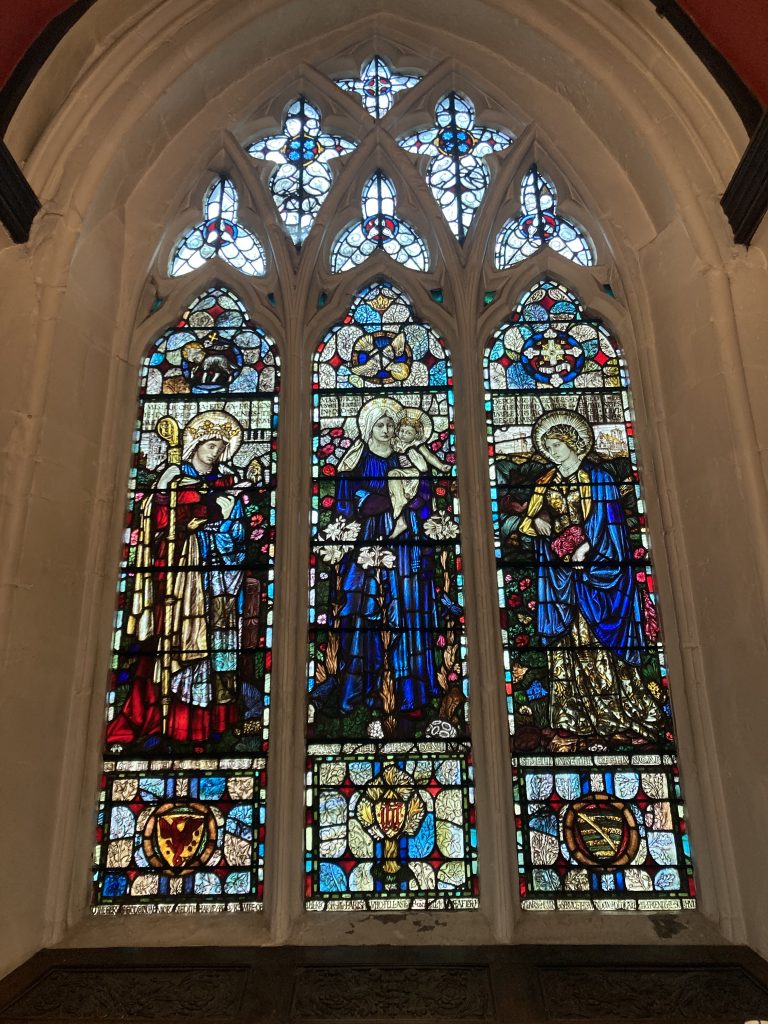
The ties proved to be insufficient, and by the 1920s temporary buttressing had to be installed in the north and south aisles until permanent stone buttresses were built in 1948. Lesser works have continued since, more recently with the help of the help of the Guardians. Stained glass has gradually been installed between the 1840s and 1970s although there is some medieval glass.
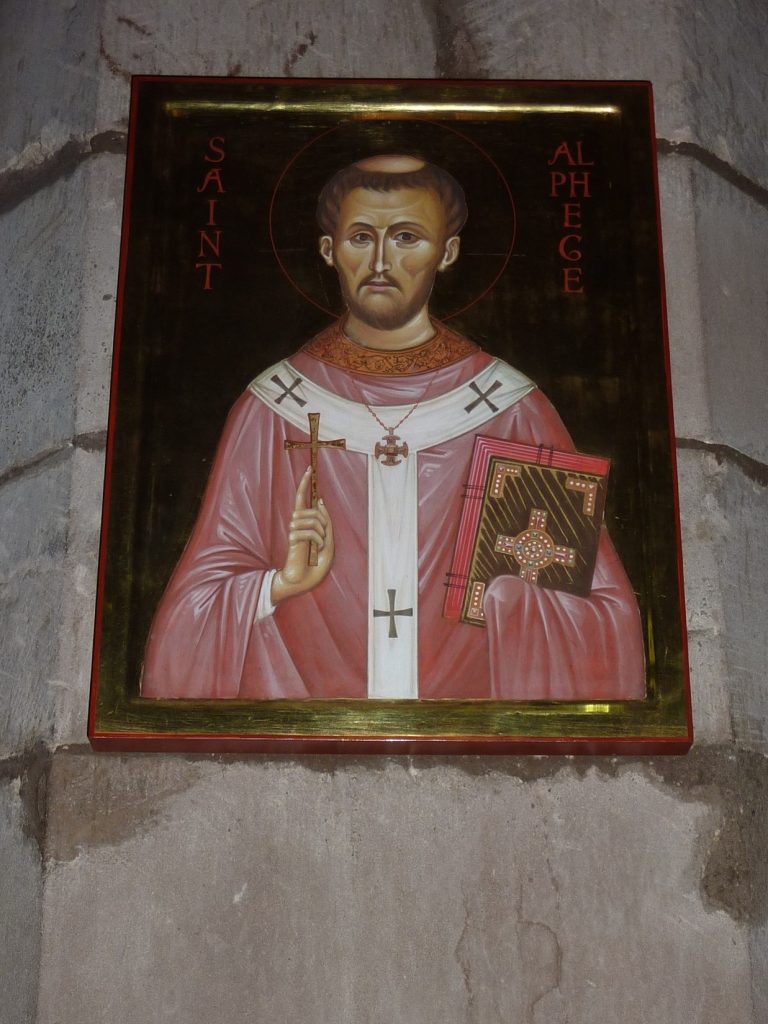
Alphege or Aelheah was born about 953. He wanted to enter the Church from an early age, and trained at Deerhurst near Tewkesbury. He was allowed to set up a hermitage near Bath, but by 972 he was Abbot of Bath. In 884 he became Bishop of Winchester, where he oversaw the completion of the Saxon cathedral and brokered some sort of peace between the English king and the king of the raiding Danes. Finally in1006 he became Archbishop of Canterbury. The peace did not last, and in autumn the Danes raided Canterbury and captured the Archbishop.
They held him at their camp in Greenwich over the winter, but Alphege refused to let anyone raise a ransom. Around Easter 1012 they hauled him out to a drunken feast and pelted him with stones and ox-bones until someone took pity on him and killed him with an axe. Many of the Danes were appalled by this act and allowed the monks to take his body away for burial in St. Paul’s cathedral. When Cnut became King of England his body was reburied in a shrine at Canterbury. This was destroyed at the Reformation, but he is still commemorated in both cathedrals.
He was the first Archbishop of Canterbury to be killed in office. There are fewer than ten churches dedicated to him, and it is not known why Solihull’s should be one of them.